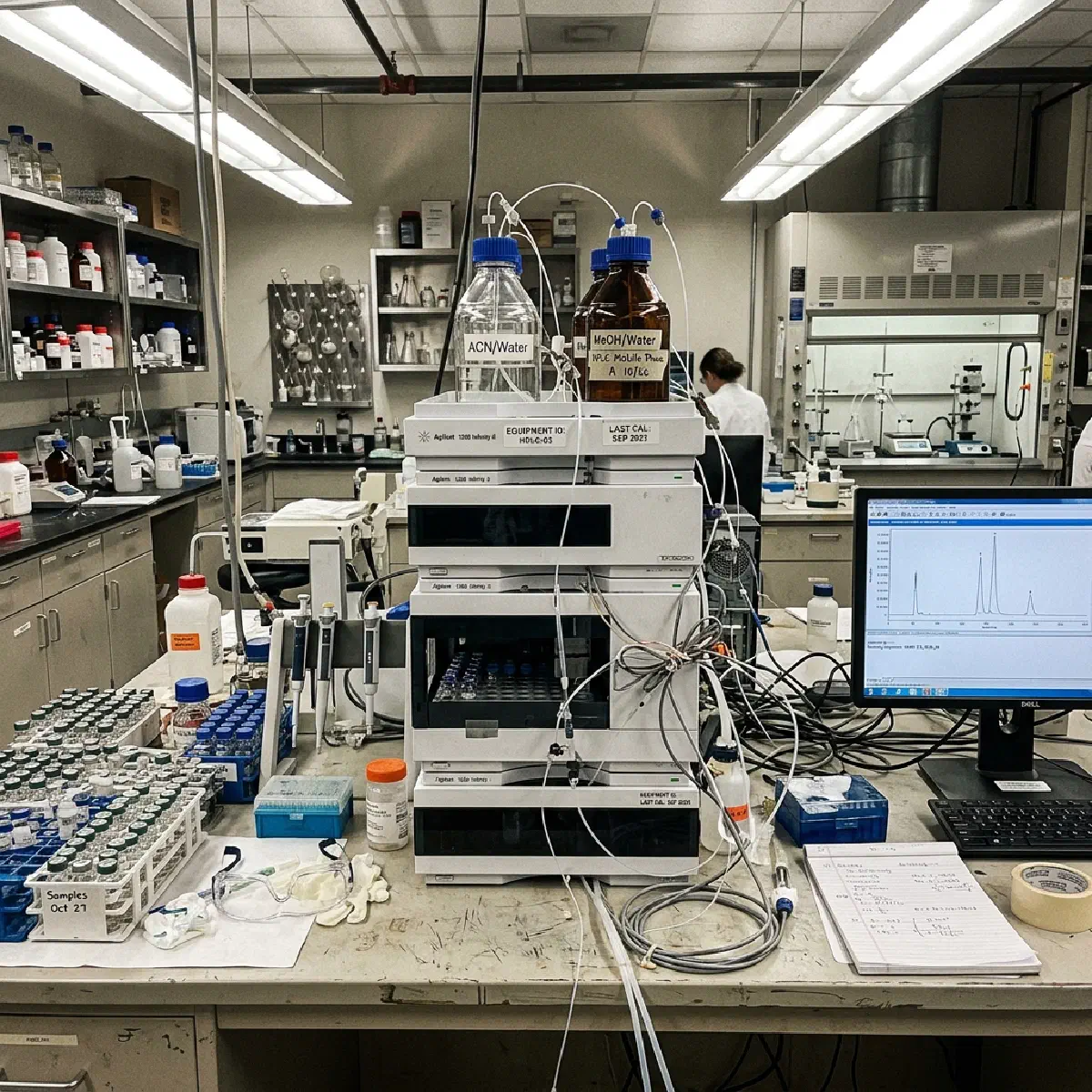
Every pharma batch produces paperwork. A lot of it. And most brand owners, receiving a batch from their contract manufacturer, file the documents without reading them â—€ assuming that if the manufacturer sent them, they must be correct.
The documents are the quality record. They tell you whether the batch that just left the factory is the batch you contracted for, at the specification you agreed to, tested to the methods the pharmacopoeia requires. A COA that isn’t read is a quality assurance system that isn’t functioning.
This guide is about reading the documents, not just holding them â—€ and about knowing which ones to ask for, what a good document looks like, and what the specific entries mean.
Related quality reading: Quality Control in Pharma Contract Manufacturing · How to Choose a Third-Party Pharma Manufacturer · Revised Schedule M GMP Compliance Guide
Document 1: The COA â—€ Your Primary Quality Evidence
The Certificate of Analysis is the summary document of a batch’s QC testing. It is what you should receive â—€ and read â—€ before accepting every batch.
What a complete COA looks like:
CERTIFICATE OF ANALYSIS

Product Name:     Azithromycin Dry Syrup 200mg/5ml
Batch No.:        SB-2026-AZI-043
Mfg. Date:        October 2026
Exp. Date:        October 2028
Batch Size:       2,000 units (30ml bottles)
Manufacturing Site: [Licensed facility name and address]

TEST RESULTS

Parameter           Specification        Result          Status
â‗€—€—€—€—€—€—€—€—€—€—€—€—€—€—€—€—€—€—€—€—€—€—€—€—€—€—€—€—€—€—€—€—€—€—€—€—€—€—€—€—€—€—€—€—€—€—€—€—€—€—€—€—€—€—€—€—€—€—€—€€
Description         White to off-white   Off-white       PASS
                    powder, free from    powder, free
                    visible particles    from particles
pH (reconstituted)  3.5 â—€œ 5.5           4.1             PASS
Assay (HPLC)        95.0% â—€œ 105.0%      98.7%           PASS
Water content       NMT 3.0% w/w        1.8%            PASS
Fill volume         30ml ± 2ml          30.2ml          PASS
Microbial limits    TAMC: NMT 100 cfu/ml   <10 cfu/ml  PASS
                    TYMC: NMT 10 cfu/ml    <10 cfu/ml  PASS

Analytical Reference: Test Report No. TR-SB-2026-AZI-043

Authorized by: [QA Manager name, signature, date]
What’s wrong with a COA that just says “PASS”:
A COA that lists parameters with only “PASS” or “COMPLIES” â—€ without the actual test results â—€ is not a valid GMP document. It tells you nothing about whether the assay is 99.8% or 95.1% â—€ both pass the 95â—€œ105% specification, but one gives you essentially no headroom if stability degrades. Insist on actual test result values.
Document 2: The BMR â—€ The Manufacturing Truth Record
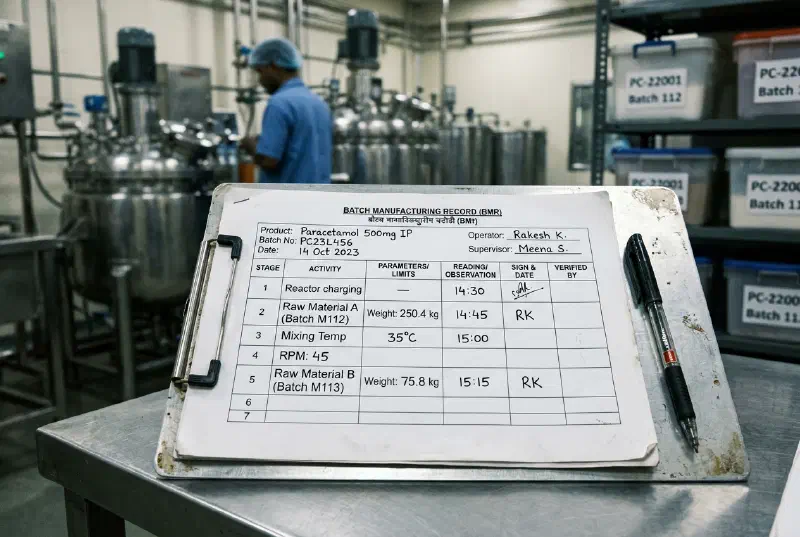
The Batch Manufacturing Record (BMR) is the document that records everything that happened during manufacturing. You won’t typically hold this document as a brand owner â—€ it stays at the manufacturer. But understanding what it contains tells you what a GMP-compliant manufacturer is doing versus one that isn’t.
A complete BMR for a liquid formulation contains:
- Raw material dispensing records â—€ each ingredient weighed and reconciled against the formula, with analyst signature and double-check counter-signature
- Equipment cleaning verification â—€ equipment cleaning status confirmed before batch start (prevents cross-contamination from previous product)
- In-process parameters â—€ temperature at mixing stages, mixing time and speed, pH at each critical step, in-process viscosity
- Hold times â—€ if the bulk was held before fill, the duration, temperature, and storage conditions are recorded
- Fill operations â—€ fill volume spot checks (number of units checked, results, acceptability)
- Deviations â—€ any process deviation from the master formula, with investigation and disposition documented
WHO GMP guidance states: “Batch records shall be retained for at least one year after the expiry date of the batch.” Under Revised Schedule M, this is enforceable domestically. [Source: WHO Technical Report Series 986]
Document 3: The BPR â—€ Where Label Errors Live
The Batch Packaging Record is the document most often overlooked by brand owners â—€ and the one most likely to catch (or miss) the errors that directly affect a patient.
Label reconciliation is the critical section:
LABEL RECONCILIATION (from BPR)

Labels issued at start of packing:    2,050 units
Labels affixed to product:            2,000 units
Labels rejected (printing defects):       45 units
Labels destroyed (reconciliation):         5 units
                                          â‗€—€—€—€—€—€—€—€€
Total accounted for:                  2,050 units ✓

Discrepancy: 0 â—€ Reconciliation PASSED

Verified by: [Packaging supervisor name, signature, date]
Any discrepancy in this reconciliation must be investigated before the BPR is approved and the batch released. Unaccounted labels are a GMP deviation â—€ always.
The Dispatch Documentation Checklist
Before accepting a batch dispatch from your manufacturer, you should hold:
| Document | Who Provides It | When You Receive It |
|---|---|---|
| COA with test report reference | Manufacturer QA | Before or with dispatch |
| Invoice and delivery challan | Manufacturer accounts | With dispatch |
| Transport declaration (if controlled substance) | Manufacturer regulatory | With dispatch |
| Cold chain temperature record (if applicable) | Transporter / manufacturer | On delivery |
| Regulatory form 26 (where applicable for interstate movement) | Manufacturer regulatory | With dispatch |
For drug license filing purposes, ask your manufacturer for:
- A sample BMR extract (anonymised) demonstrating their documentation standard
- Stability data for the product (at minimum 3 months accelerated at 40°C/75% RH)
- Analytical test report template for the product category
Conclusion
The documents are the quality system. A COA with actual test values tells you the batch is what you contracted for. A BMR that a manufacturer can produce on request tells you their process is under control. A BPR with clean label reconciliation tells you the right product is in the right box.
Ask for them. Read them. File the ones that pass and investigate the ones that don’t.