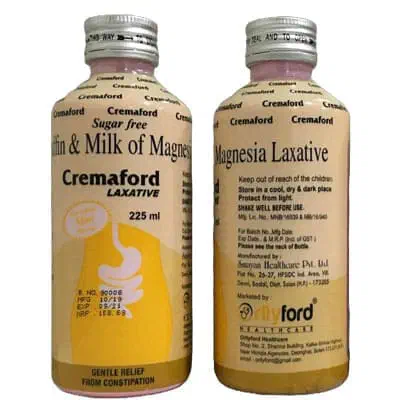
Milk of Magnesia + Liquid Paraffin suspension doesn’t get the spotlight that sodium alginate or sucralfate gets in discussions of gastro portfolio planning. It doesn’t have the mechanistic complexity of a raft-forming suspension or the urgency of an acute ulcer treatment. What it has is something commercially more durable: a very large, very consistent prescribing population that returns month after month for the same product.
Elderly patients on multiple medications. Pregnant women. Post-surgical patients. Anyone on long-term opioids, iron supplements, or calcium channel blockers. These patients have chronic, low-grade constipation with concurrent hyperacidity — and Milk of Magnesia + Liquid Paraffin manages both with a single, mild, well-tolerated product. That’s why gastroenterologists, general physicians, and obstetricians have been writing this product for decades, and why physicians who trust your MOM + LP brand write it repeatedly across a patient relationship.
Building a complete gastro portfolio?
See our Antacid & Gastro Suspension Guide for the full category map, or browse Sodium Alginate Suspension for GERD-specific positioning.
The Mechanism: Why Two Laxative Types Together
Magnesium Hydroxide and Liquid Paraffin work by completely different mechanisms — which is why combining them produces a more effective and more comfortable laxative effect than either alone.
Magnesium Hydroxide (osmotic): Draws water into the intestinal lumen osmotically. The increased water content softens the stool and increases stool bulk, stimulating peristalsis. Effect onset: 6–12 hours. Does not cause cramping at standard laxative doses. Also provides antacid effect in the stomach at any dose.
Liquid Paraffin (lubricant): Coats the stool surface with a layer of mineral oil, reducing friction against the intestinal wall and facilitating passage. Also softens the stool from the surface inward. Does not cause cramping or secretory effects. Particularly valuable in post-surgical and elderly patients where strong laxatives are contraindicated.
Together: gentler than stimulant laxatives, effective for chronic mild-to-moderate constipation, and simultaneously managing the hyperacidity that frequently accompanies gut dysmotility in the same patient population.
The Key Manufacturing Challenge: Phase Separation
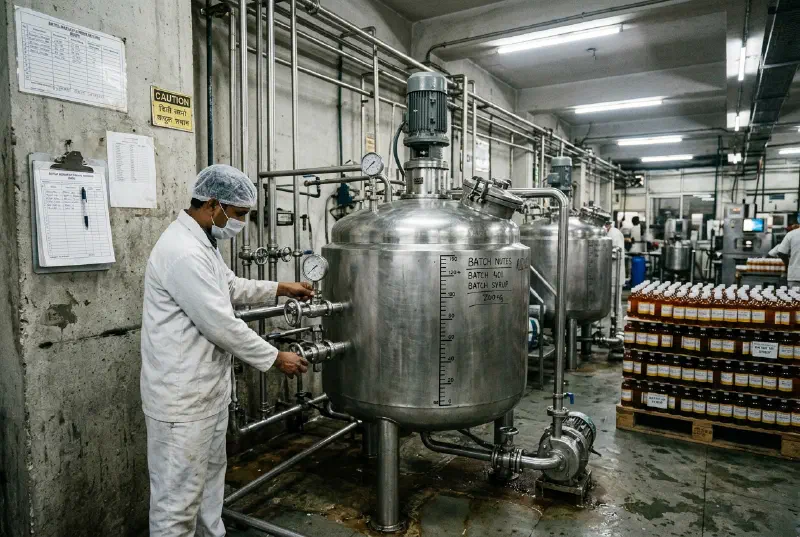
The primary technical challenge in MOM + LP manufacturing is emulsification. You are combining an oil-phase (Liquid Paraffin) with an aqueous suspension (Magnesium Hydroxide in water). Without proper emulsification, the Liquid Paraffin separates to the surface of the bottle on standing — visibly, within days.
What phase separation looks like to a patient: An oily layer on top of what should be a uniform milky suspension. A patient who sees this — and patients notice — concludes the product is defective or degraded. The prescription doesn’t get written again.
What good manufacturing addresses:
| Manufacturing Parameter | What It Controls | Quality Outcome |
|---|---|---|
| Emulsifier selection and concentration | How well oil phase disperses and stays dispersed | Phase separation rate on storage |
| Homogenisation time and shear rate | Droplet size of oil phase in continuous phase | Stability and smooth texture |
| Viscosity control (suspending agent) | Rate at which any settled or separated phase settles | Shelf-life phase stability |
| Fill temperature | Viscosity at fill point — affects fill accuracy | Dose uniformity |
| Shake-and-observe redispersibility test | Batch QC — does it redisperse within N shakes? | Retail-ready quality assurance |
Pack Sizes and Packaging Specifications
| Pack Size | Commercial Context |
|---|---|
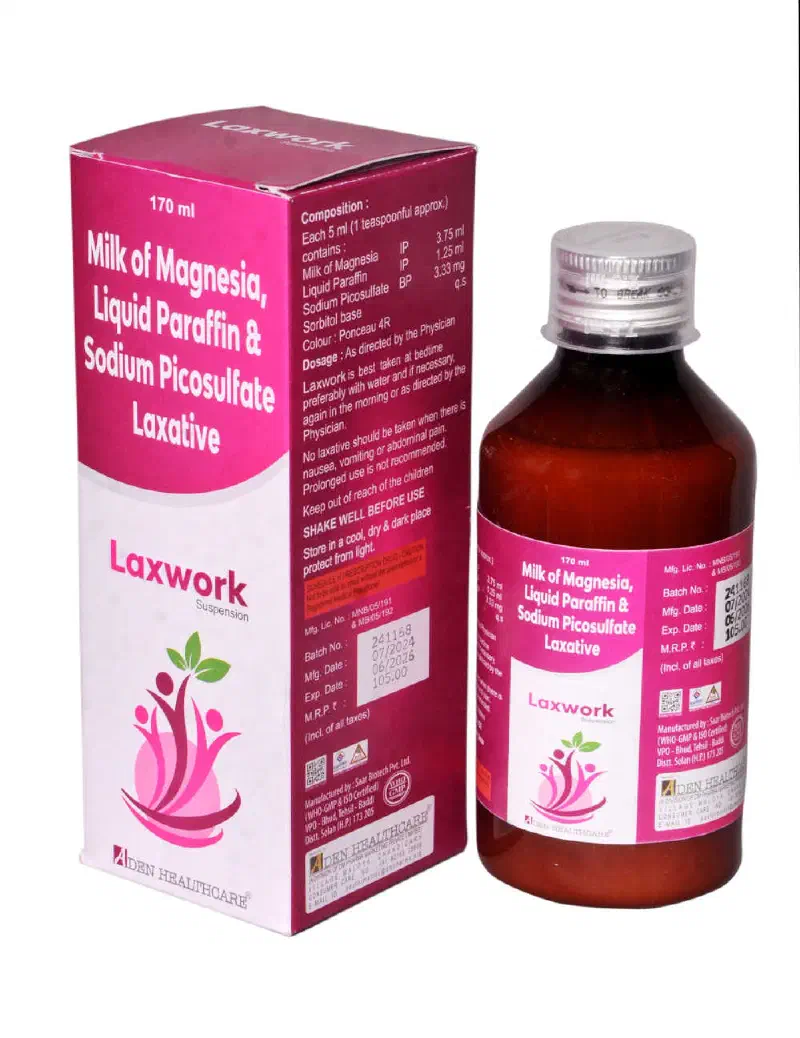
| 170ml amber PET bottle + measuring cup | Standard prescription format — most commonly dispensed |
| 200ml amber PET bottle + measuring cup | Slightly larger pack; useful for chronic constipation patients on regular use |
| 450ml/500ml | Hospital or institutional supply — not typically for retail brand |
Why amber PET? Magnesium Hydroxide is light-stable, but the combination product should be protected from heat and light to maintain the emulsion integrity. Amber PET provides light protection; a tight HDPE closure or aluminium-lined cap prevents moisture vapour transmission.
The measuring cup is non-negotiable. Dose accuracy is volume-dependent (the prescription specifies 15ml or 30ml doses, not tablet counts), and patients measuring in kitchen spoons routinely under- or overdose. A 30ml or 45ml measuring cup packed inside the carton is the minimum patient-safety standard.
Formulation Variants Available
Also available in the MOM category:
- Activated Dimethicone + Magnesium Hydroxide + Aluminium Hydroxide Suspension — for hyperacidity with gas (different indication from constipation)
- For GERD: Sodium Alginate Raft-Forming Suspension
- For peptic ulcer: Sucralfate + Oxetacaine Suspension
What to Include in Your Manufacturing Enquiry
When you send a MOM + LP enquiry to Saar Biotech or any manufacturer, include:
Product: Milk of Magnesia + Liquid Paraffin Suspension
Composition: Magnesium Hydroxide IP [x]% w/v + Liquid Paraffin IP [x]% w/v
Pack Size: 170ml amber PET bottle + 30ml measuring cup + carton
Flavour: Mint (specify alternatives if needed)
Quantity: [units for first batch]
Target Dispatch: [date]
Questions:
  - Is this a validated formulation with existing stability data?
  - Can you share an existing COA for batch release reference?
  - What is your batch redispersibility protocol?
Specifying the flavour, the measuring cup, and asking about emulsion validation upfront saves 2–3 rounds of back-and-forth.
Conclusion
Milk of Magnesia + Liquid Paraffin suspension earns its place in every complete gastro portfolio not through clinical drama, but through steady, chronic-prescribing frequency across a large and consistent patient population. The manufacturing challenge — emulsion stability — is solvable with the right process, and the product that solves it correctly earns repeat prescriptions month after month from the physicians who trust it.
Ready to add MOM + LP to your gastro range?