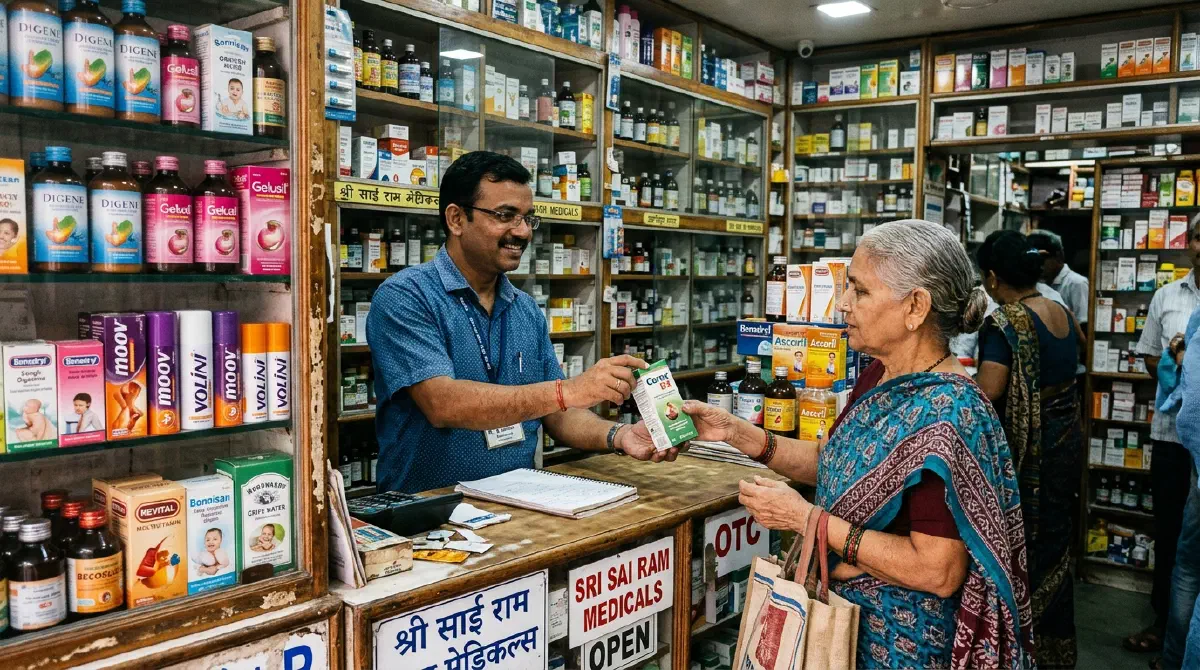
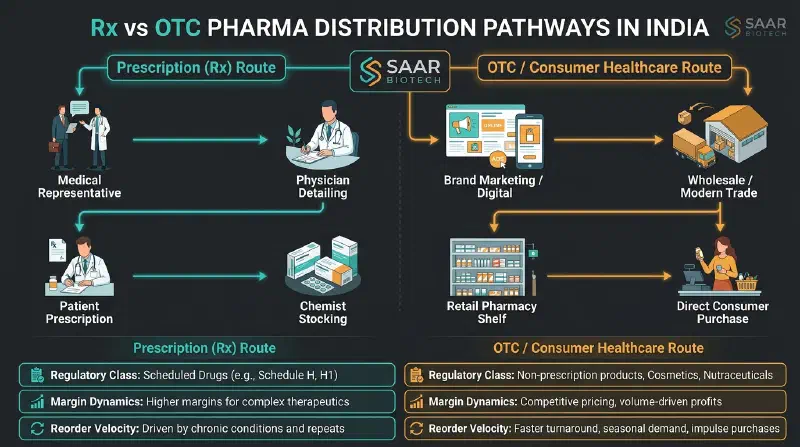
Pharmaceutical retail in India is changing in a direction that creates opportunity for brands who understand where the market is moving: consumers are increasingly buying pharma products at the pharmacy without a prescription — choosing their own antacid, their pain gel, their vitamin supplement, their saline nasal spray — based on the brand they recognise, the packaging that communicates quality, and the product that worked last time.
This isn’t a shift away from prescription medicine. It’s an additional, parallel behaviour. And it’s growing.
For a pharma marketing company, this growth has a specific implication: a well-designed OTC product in the right category can build prescription momentum through pharmacy-level recognition — and pharmacy purchases that build repeat consumer purchase patterns, regardless of physician recommendation.
Verify all market size and growth rate figures from current industry reports (IQVIA, AIOCD, Express Pharma) before any business planning — figures in articles become outdated faster than the category trends they describe.
Related reading: Best Products to Start a Pharma Marketing Company · PCD vs Third-Party Manufacturing — Which Model Is Right?
The Highest-Growth OTC Categories in Indian Pharma
1. Antacid and Digestive Health
Antacid self-medication is one of the most established OTC behaviours in India — patients buy antacids at pharmacies without a prescription across all income segments and geographies. The growth in this category is driven by the shift from very basic antacid tablets to more sophisticated products: raft-forming suspensions, effervescent antacids, and gastric comfort products that are positioned around wellness rather than disease.
OTC opportunity: Sodium alginate raft-forming suspension is one of the strongest OTC-adjacent gastro products — its mechanism is explainable to a consumer without physician mediation, and its raft-forming action is visible (or at least perceptible) after use. This makes it a product that can generate retail word-of-mouth.
View Sodium Alginate Suspension
2. Pain Relief Topicals
Topical pain gels, sprays, and roll-ons are overwhelmingly purchased OTC in Indian pharmacies — the pharmacist’s recommendation drives a significant share of Diclofenac topical purchases, not the physician’s prescription. This makes the category particularly responsive to pharmacy relationship-building and in-store brand visibility.
OTC opportunity: Diclofenac roll-on specifically benefits from OTC dynamics — its applicator format, convenience positioning, and sports/gym marketing associations all drive direct purchase rather than prescription-driven purchase.
View Diclofenac Roll-On · Diclofenac Gel
3. Vitamins and Nutraceuticals
Vitamin D3, B12, iron, zinc, and multivitamin preparations have a strong and growing OTC purchase base in urban India. The Vitamin D3 category in particular has seen very high growth, driven by widespread deficiency awareness and physician recommendations that have driven the category into mainstream consumer health.
OTC opportunity: Vitamin D3 shots (nano-emulsion format for better bioavailability) occupy a premium positioning in the Vitamin D3 category that commands an OTC price point above the commodity sachet formats.
4. Saline Nasal Sprays
Saline nasal sprays are purchased OTC for nasal hygiene, allergic rhinitis management, dry nose relief, and post-operative nasal care. The category has grown significantly with increased awareness of nasal hygiene practices — particularly post-2020. Saline nasal spray has no prescription requirement, minimal regulatory complexity, and a direct consumer benefit communication story.
View Sodium Chloride Nasal Spray
5. Wound Care and Dermatology
Calamine lotion, wound antiseptic preparations, and basic skincare products with pharmaceutical credentials have a strong OTC positioning at the pharmacy-skincare boundary. The pharma brand has a quality credential that cosmetic brands lack; the packaging and price point need to match a consumer health expectation.
View Calamine + Allantoin + Vitamin E Lotion

The Compliant Claims Rule — Non-Negotiable
OTC marketing in India has more marketing creativity than prescription marketing (which is tightly regulated by the UCPMP and CDSCO guidelines) — but it does not mean claims are unconstrained. Every claim on an OTC product must be:
- Within the scope of the approved drug composition — an antacid product can claim antacid benefit; a plain saline spray cannot claim to “treat sinusitis”
- Not a disease cure claim without regulatory basis — “Provides relief from acidity” vs “Cures GERD” is the distinction
- Consistent with the drug’s schedule and classification — Schedule H drugs cannot be marketed as OTC products
OTC Packaging: The Three-Second Rule
The difference between a prescription product and an OTC product, commercially, is where the purchase decision is made. In prescription medicine, the physician decides; the patient receives. In OTC, the consumer decides at the pharmacy counter or the online cart.
This shifts the entire communication challenge to the packaging. An OTC product that doesn’t communicate its core benefit, quality signal, and differentiation within three seconds of being picked up from a shelf loses the purchase to the product next to it.
Three-second packaging test for OTC products:
| Element | What It Must Communicate in 3 Seconds |
|---|---|
| Front label headline | What this product does for you — in plain language |
| Visual identity | Professional, quality-signalling — not generic pharmaceutical austerity |
| Product format visibility | The consumer should be able to tell what physical form the product is without reading |
| Differentiation cue | “Sugar-free,” “Fast-acting,” “Natural mint,” “Pump-dispensed” — one specific claim that separates it |
Product Selection Checklist for OTC Focus
Before selecting a composition for OTC-oriented marketing, run this quick checklist:
- Is the drug schedule OTC-compatible (not Schedule H or H1)?
- Is the composition mechanism easily communicated in a single sentence?
- Does the product have a self-treatable indication (no physician diagnosis required)?
- Is the dosage form convenient for self-administration?
- Is the pack size and price point accessible at the pharmacy OTC purchase level?
- Is your packaging designed for consumer shelf appeal, not just regulatory compliance?
Conclusion
India’s OTC and consumer healthcare segment is not a niche — it’s a large, growing, and commercially accessible market for brands who combine smart product selection, compliant claims, and pharmacy-level packaging investment. The opportunity is real and the categories are clearly identifiable.
The brands that capture it are the ones who take the packaging as seriously as the formulation, and who treat compliant claims as a commercial discipline rather than a constraint.
Ready to discuss an OTC product brief?